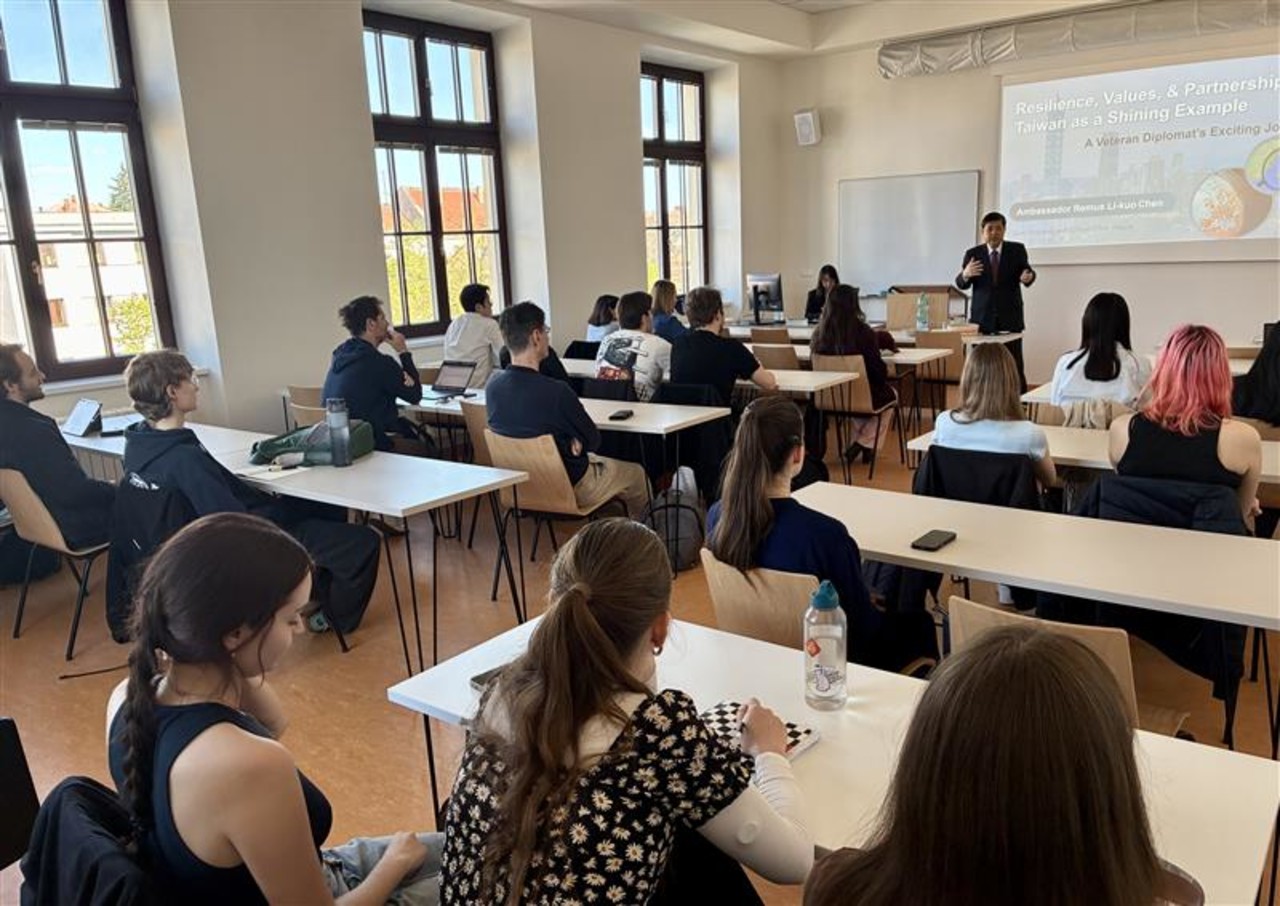
As part of the Global Taiwan Chair project, the Department of Asian Studies at Palacký University Olomouc introduced a new course, Taiwan in the World, taught by Kristina Kironska, author of Contemporary Taiwan: More than a Flashpoint. The course examined Taiwan’s foreign policy and its global positioning in a rapidly shifting international environment.
Offered to both Bachelor’s and Master’s students—and open to participants from across the Faculty of Arts—the course responded to a clear gap: while Taiwan is increasingly visible in debates on security, technology, and democracy, structured academic engagement with how it is perceived worldwide remains limited.
Early sessions provided students with an overview of Taiwan’s history, political system, economy, and society. Building on this, the course then shifted toward Taiwan’s foreign policy and its interactions across regions, moving beyond a purely cross-Strait lens to a more global perspective.
What set the course apart was its methodological component. Students worked with original data from the Sinophone Borderlands Surveys (2022), allowing them to engage directly with public opinion data on how Taiwan is perceived in different countries.
The course also integrated several guest contributions. Visiting Taiwanese scholar Yu-Sung Su delivered a lecture on cross-Strait relations, our PhD candidate Klára Schwarzová presented a case study on Taiwan–Czech relations, and Remus Li-Kuo Chen, representative of the Taipei Economic and Cultural Office in Prague, delivered a guest lecture titled “Resilience, Values & Partnership: Taiwan as a Shining Example.” His talk connected classroom discussions to current diplomatic practice, offering students a firsthand perspective on how Taiwan navigates its international space.
In the final weeks, the course shifted responsibility to the students. Each participant selected a country—ranging from Japan to Eswatini—and examined its relationship with Taiwan. Their analysis combined policy perspectives with public opinion data, culminating in presentations that highlighted both patterns and inconsistencies in how Taiwan is engaged globally.