
As I conclude my visit to Palacký University Olomouc under the Global Taiwanese Chair program, I find myself reflecting not only on the past month but also on a much earlier stage of my academic journey. During my Ph.D. fieldwork in 2007, I had intended to include Eastern Europe as part of my research itinerary but was ultimately unable to do so. This residency therefore felt, in some sense, like a return to an unfinished intellectual aspiration. The fellowship provided both the institutional platform and the temporal space to engage meaningfully with Czech academia while contributing perspectives on Taiwan and cross-strait relations to a Central European audience.
Olomouc, though modest in size, carries a deep historical presence. Its layered architectural landscape and its proximity to major European cities situate it within a broader cultural and political geography that makes scholarly exchange particularly valuable. My principal objective during this stay was to contribute to dialogue between Taiwanese and Czech scholars, especially by clarifying Taiwan’s evolving relationship with China and the broader strategic implications of cross-strait developments. I am sincerely grateful to Dr. Kristina Kironska and Dr. Richard Turcsányi for their warm hospitality and intellectual generosity, and to the Department of Asian Studies for providing essential logistical support. Above all, I wish to acknowledge the Global Taiwanese Chair program for making this visit possible.
Arriving in early February, I encountered Olomouc in its quiet winter stillness. The semester had not yet begun, and this slower rhythm allowed me to observe the city attentively and to prepare for my academic engagements. During the first week, I traveled to Prague, whose historic skyline and architectural continuity vividly embody the cultural memory of Central Europe. Walking across Charles Bridge toward the castle district, one senses a city that has preserved its historical contours while accommodating contemporary life. Later in the month, I returned to Prague to deliver a lecture at the Prague University of Economics and Business, experiencing the city again from an academic vantage point. In both instances, Prague revealed itself as simultaneously historical and modern, a fitting metaphor for the region’s evolving political identity.
In Olomouc, Richard’s introductory tour of the city provided an immediate sense of orientation. The old town square, riverside paths, neighborhood cafés, and university buildings soon became part of my daily routine. Through conversations with colleagues, I gained insight into Czech–Taiwan academic exchanges, including the establishment of a Taiwan Corner within the department’s library. These initiatives reflect broader developments in Czech–Taiwan relations and are shaped in part by the enduring moral and political legacy of Václav Havel, whose influence continues to inform Czech public discourse regarding authoritarianism and democratic solidarity.
A major component of my residency involved public lectures. My first presentation in Olomouc examined strategic communication between Beijing and Taipei. Using game-theoretical frameworks — particularly variations of the chicken game and prisoner’s dilemma — I illustrated how signaling, perception, and misperception structure cross-strait interactions. Despite coinciding with a Czech Olympic hockey match, the discussion was animated and thoughtful. Audience members were especially interested in the conditions under which escalation might become likely and how miscalculation could be prevented. While I acknowledged that strategic signaling may serve communicative purposes between adversaries, I emphasized that the absence of institutionalized dialogue channels heightens the risks of unintended conflict.
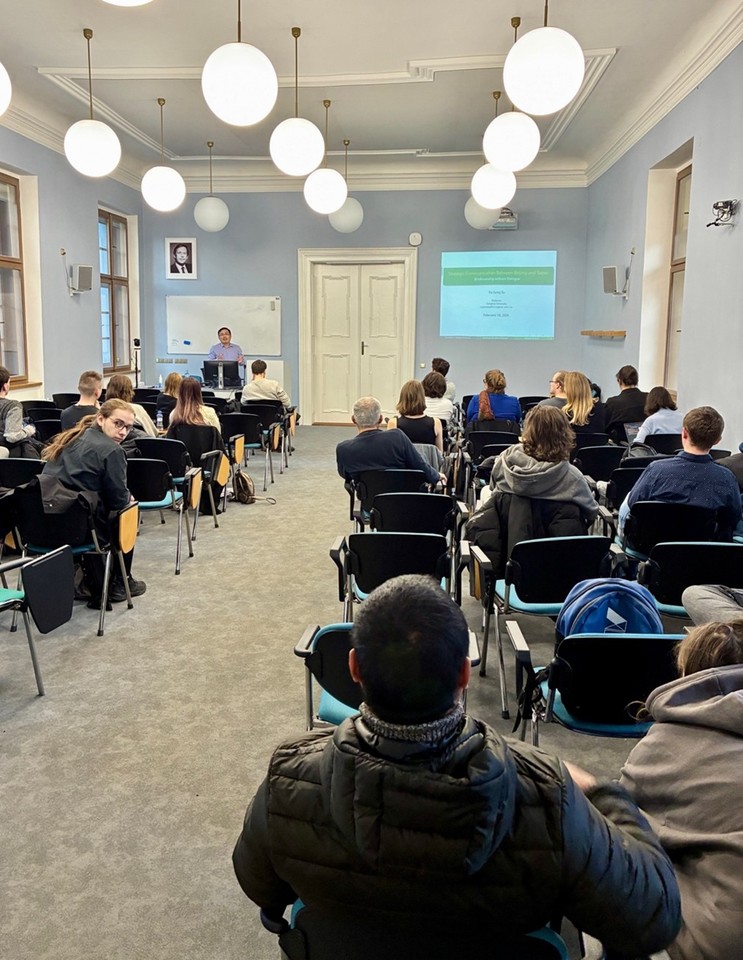
I later delivered a similar lecture in Prague, adjusting the framing to address a different academic audience. Once again, questions centered on war probability and deterrence dynamics. These discussions reinforced for me the importance of presenting Taiwan’s security dilemmas within analytically rigorous frameworks while also underscoring the shared global concern over Indo-Pacific stability.

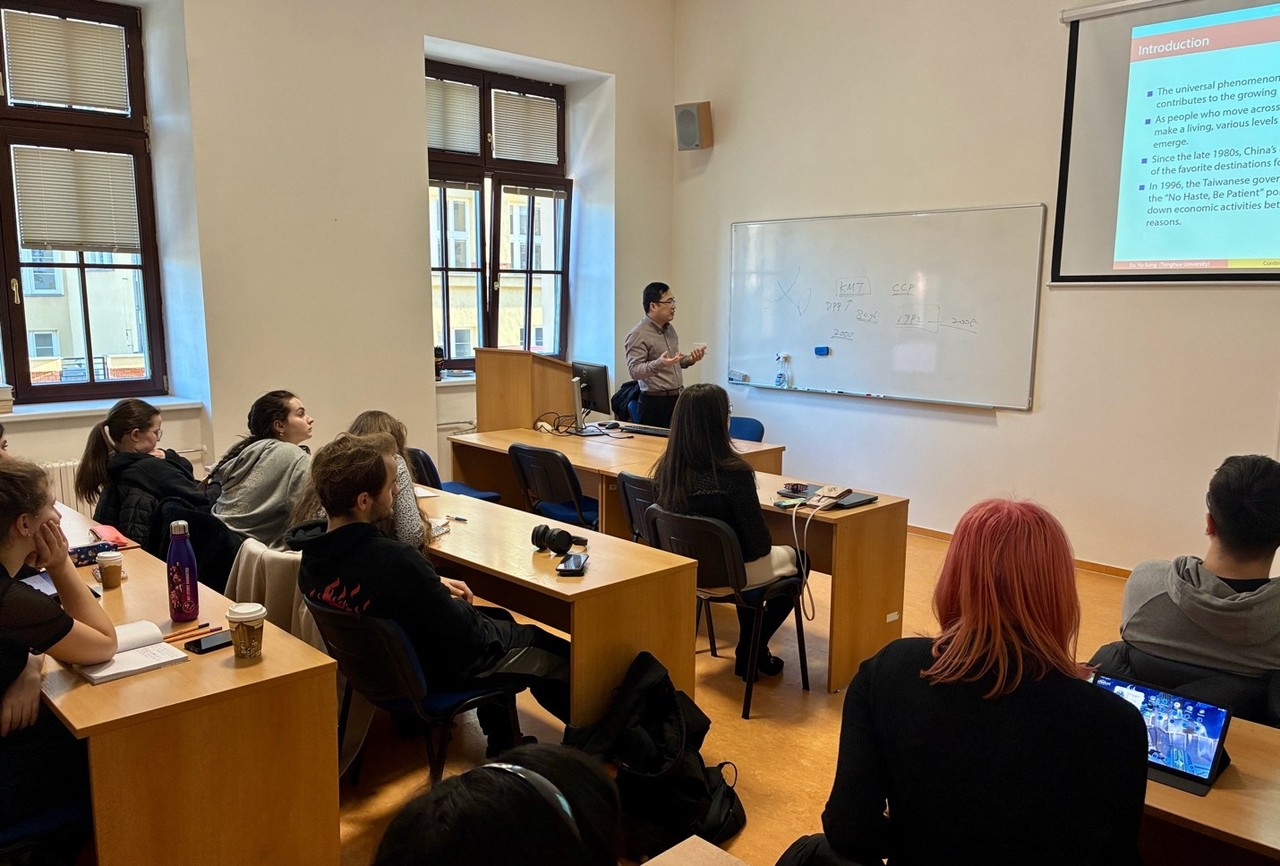
At the conclusion of my visit, I had the opportunity to give a final lecture in Kristina’s class Taiwan in the World, this time focusing on cross-strait trade relations from a historical perspective. I introduced students to Taiwan’s “No Haste, Be Patient” policy of the 1990s, explaining its origins as a state attempt to regulate outbound investment to China. Using the game-theoretical “pigs model” alongside veto-player theory, I analyzed how Taiwanese business actors and domestic political constraints gradually undermined the policy’s sustainability. The episode illustrates a broader political economy lesson: market forces, when supported by aligned domestic coalitions, often override restrictive state interventions. Yet I also encouraged students to consider how institutional evolution and shifting geopolitical pressures have shaped Taiwan’s more recent New Southbound Policy. The discussion became particularly lively when we examined how China has employed trade as a coercive instrument and how the Taiwanese government has sought to respond through diversification strategies. Students expressed strong interest in these cross-border dynamics and the interaction between economic interdependence and political leverage.
Beyond the Czech Republic, I visited Budapest during one weekend, which offered a comparative perspective within the post-socialist region. Observing differences in political atmosphere and external orientation between countries often grouped together in democratic transition studies highlighted the diversity of Central European trajectories. Such comparisons deepened my appreciation for how domestic political developments shape attitudes toward China, Taiwan, and broader geopolitical alignments.
One particularly striking moment occurred when I encountered a large political gathering in Olomouc’s old town square after weeks of relative quiet. The sudden visibility of civic mobilization served as a reminder of the vibrancy and fluidity of democratic politics. Public opinion, even toward newly elected governments, can shift rapidly — a phenomenon not unfamiliar in Taiwan’s own democratic experience.
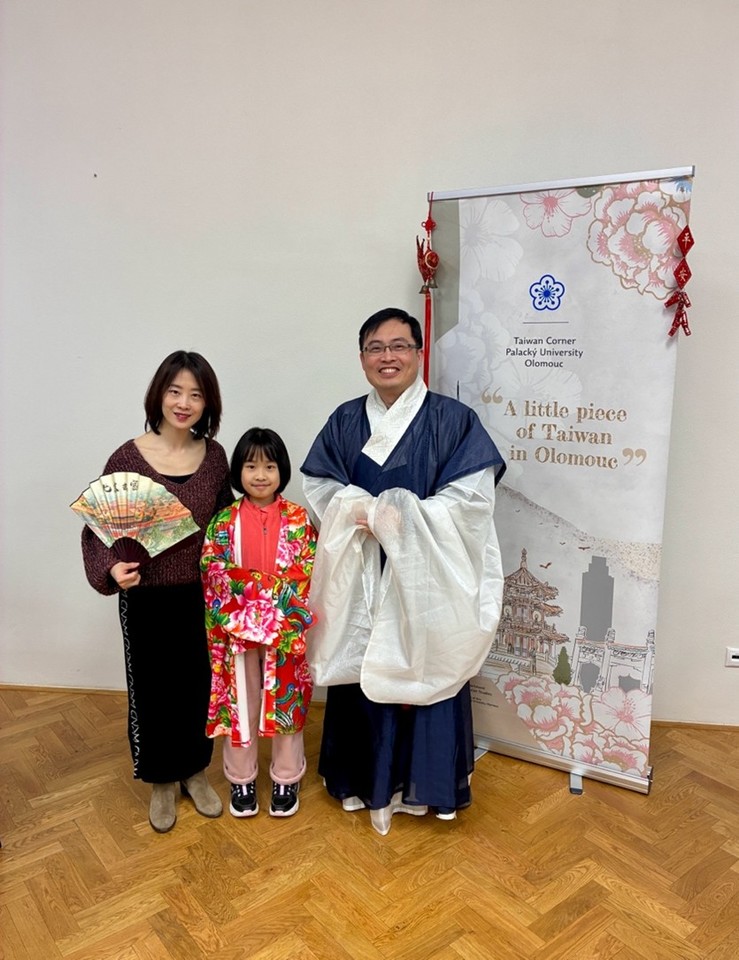
The coincidence of my visit with the Lunar New Year added a meaningful cultural dimension. Attending a celebration organized by the Department of Asian Studies illustrated the presence of active Asian cultural engagement within Czech academia. It also demonstrated that interest in Taiwan and China continues to coexist in complex and evolving ways.
Overall, this residency broadened my engagement with academic communities beyond a U.S.-centered scholarly environment and reaffirmed the importance of cross-regional dialogue. At a time marked by intensifying geopolitical competition among major powers, the opportunity to articulate Taiwan’s perspective within a Central European setting felt especially significant. This experience has strengthened my commitment to sustained academic exchange and to fostering deeper mutual understanding between Taiwan and the Czech Republic. I conclude this visit with sincere gratitude and with the hope that the intellectual connections established here will continue to grow in the years ahead.