The Czech Republic occupies a unique place in European history, particularly in the context of resistance to communist authoritarianism. Its enduring resilience in the face of overwhelming political pressure offers a unique historical lens through which questions of sovereignty, democratic governance and civil courage can be examined. It is within this broader spirit of democratic perseverance that my fellowship with the Global Taiwan Chair program finds intellectual grounding. Taiwan represents a compelling case for sustaining democratic institutions and civic spaces within a deeply contested geopolitical environment. Engaging with Palacký University Olomouc (UPOL) is therefore not merely an academic exercise but an opportunity to situate contemporary political questions within a richer and deeper European historical experience.
My fellowship focuses on Tibetans in Taiwan, with a special focus on stateless populations, a subject that intersects with broader discussions about Taiwan’s democratic development and international standing. It remains a relatively underexplored area of enquiry, and at times a sensitive one, despite a growing body of critical scholarship on migrant and stateless communities in Taiwan. In this regard, I wish to extend my sincere gratitude to the funder, Taiwan’s Ministry of Foreign Affairs, and to Dr. Kristina Kironska for creating an intellectual space to critically engage with this issue before broader academic audiences in Europe.
Before arriving in Olomouc for the fellowship, I participated in the 2026 Annual Forum of the Central European Institute of Asian Studies (CEIAS), a think tank affiliated to the UPOL Department of Asian Studies, held under the theme “Geo-Tech Frontiers: Europe’s Strategic Stakes in the Indo-Pacific.” I had the opportunity to contribute to the panel titled “Do Human Rights Still Matter to the Pragmatic Turn of the EU’s Indo-Pacific Strategy?” In a forum largely dominated by discussions of technological sovereignty and Europe’s strategic recalibration in relation to China, the world’s second-largest economy, the question of human rights risks being marginalised. It was therefore both timely and necessary to foreground this dimension alongside scholars such as Prof. Jagannath Panda, Dr. Kristina Kironska, and Heiner Janus, reflecting critically on the human rights situation in Tibet, China, particularly in the context of the EUs approach to human rights within its broader Indo-Pacific engagement.
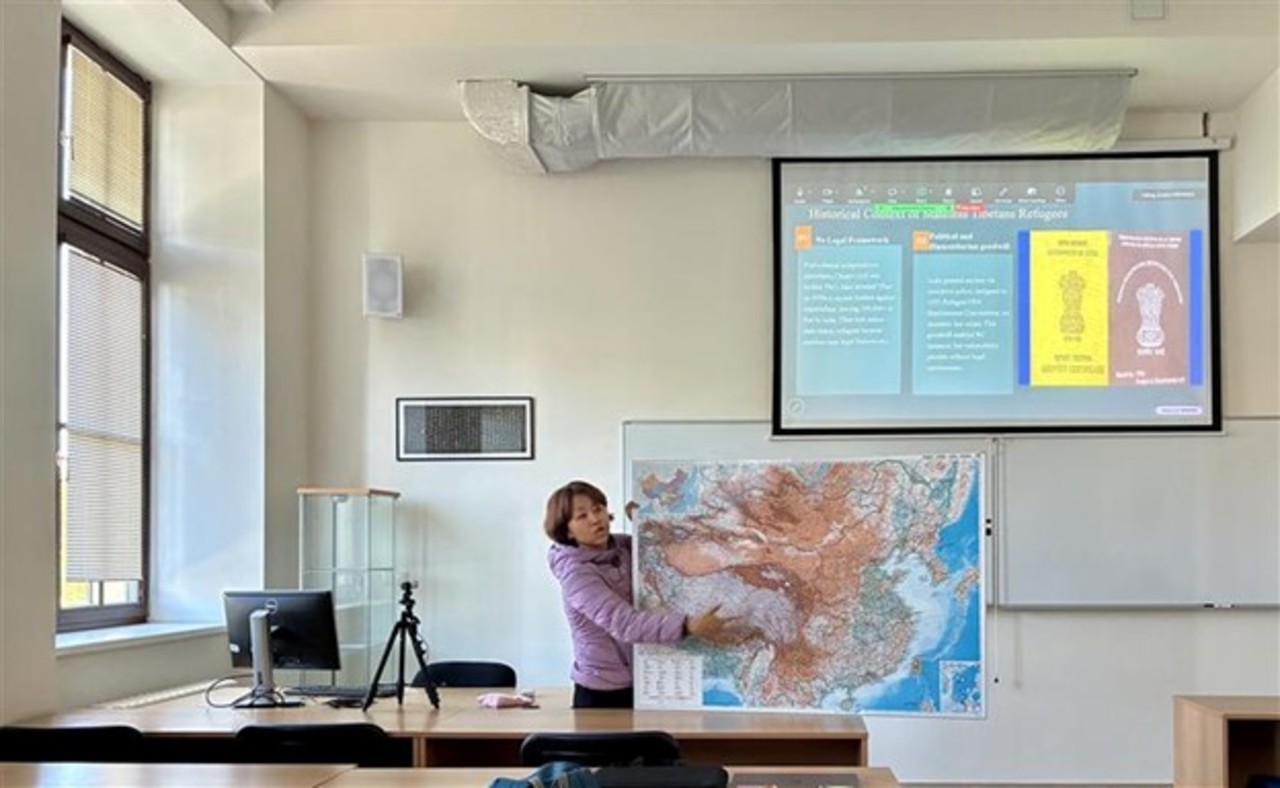
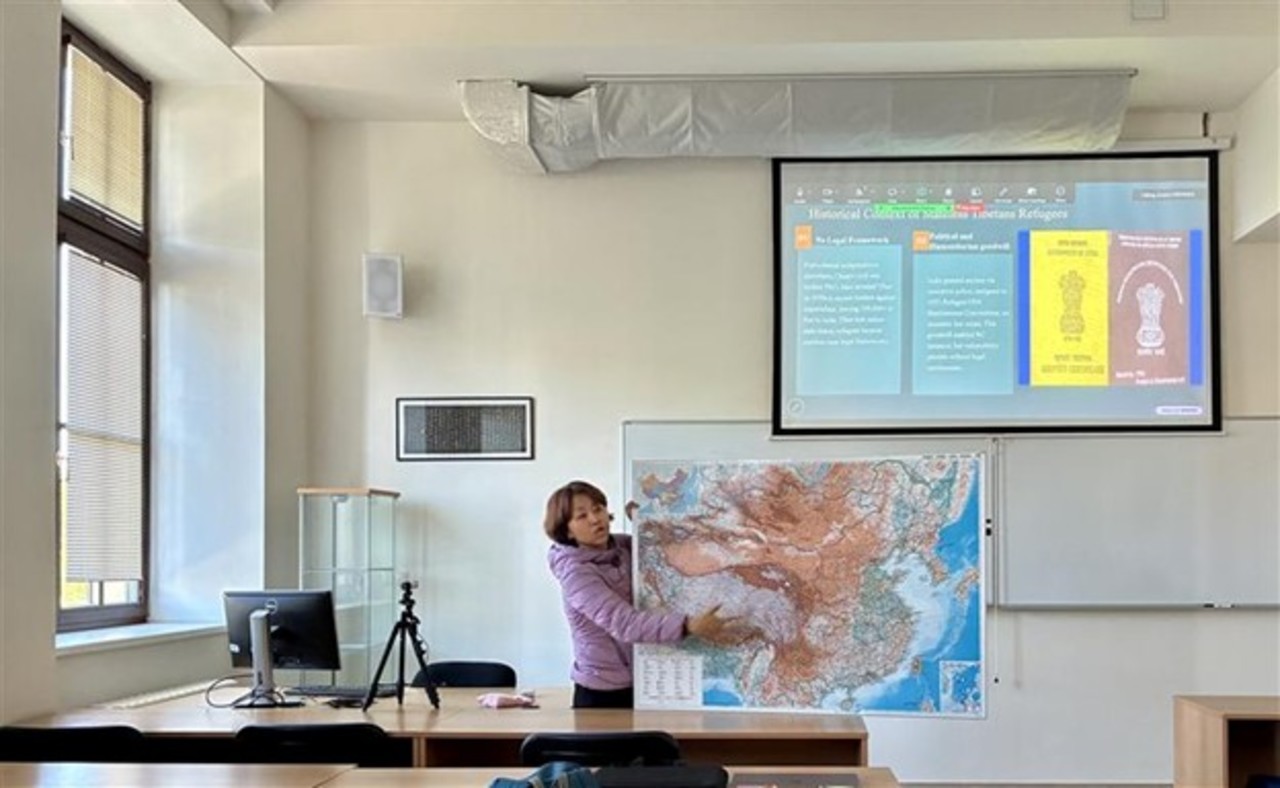
Once in Olomouc, a particularly memorable engagement during the fellowship was a guest lecture on human rights delivered to students of the course Human Rights in Asia, where I presented my perspectives on human rights from the standpoint of stateless peoples. Upon entering the classroom, I was struck by the presence of two large maps: one of China and one of the Himalayan region, where Tibet stands out with remarkable clarity owing to its distinctive geography and geopolitical significance. Presenting before students who had largely encountered these questions through an academic or policy lens, rather than through lived experience, created a meaningful engagement that underscored the value of bringing experiential knowledge into scholarly conversation.
In collaboration with Dr. Kristina Kironska we worked on two short articles to be published soon: 1, "The Securitized Monk: Tibetan Buddhism Between China’s Persecution and Taiwan’s Democratic Contradictions" (CEIAS Insights), and 2, "Taiwan’s Democratic Blind Spot: Statelessness and Legal Exclusion" (The Diplomat).
During this period, I also had the opportunity to travel to Germany for a few days and present my research at the Tibet and Himalayan Studies Centre at the University of Bonn with the Centre’s support. This was an enriching intellectual encounter with scholars who have dedicated years to in-depth research on Tibet’s history, culture, and society. The visit to Germany further offered an opportunity for historical reflection, engaging with pivotal moments in European history, including the fall of the Berlin Wall, the memory of humanitarian atrocities against Jewish communities during the Holocaust, and the profound human costs of the Cold War division of the country. These encounters were not incidental to my academic visit but were deeply relevant to understanding how societies process historical trauma, resist authoritarianism, and build frameworks for justice and memory–questions that remain unresolved for many communities across Asia, including Tibet.
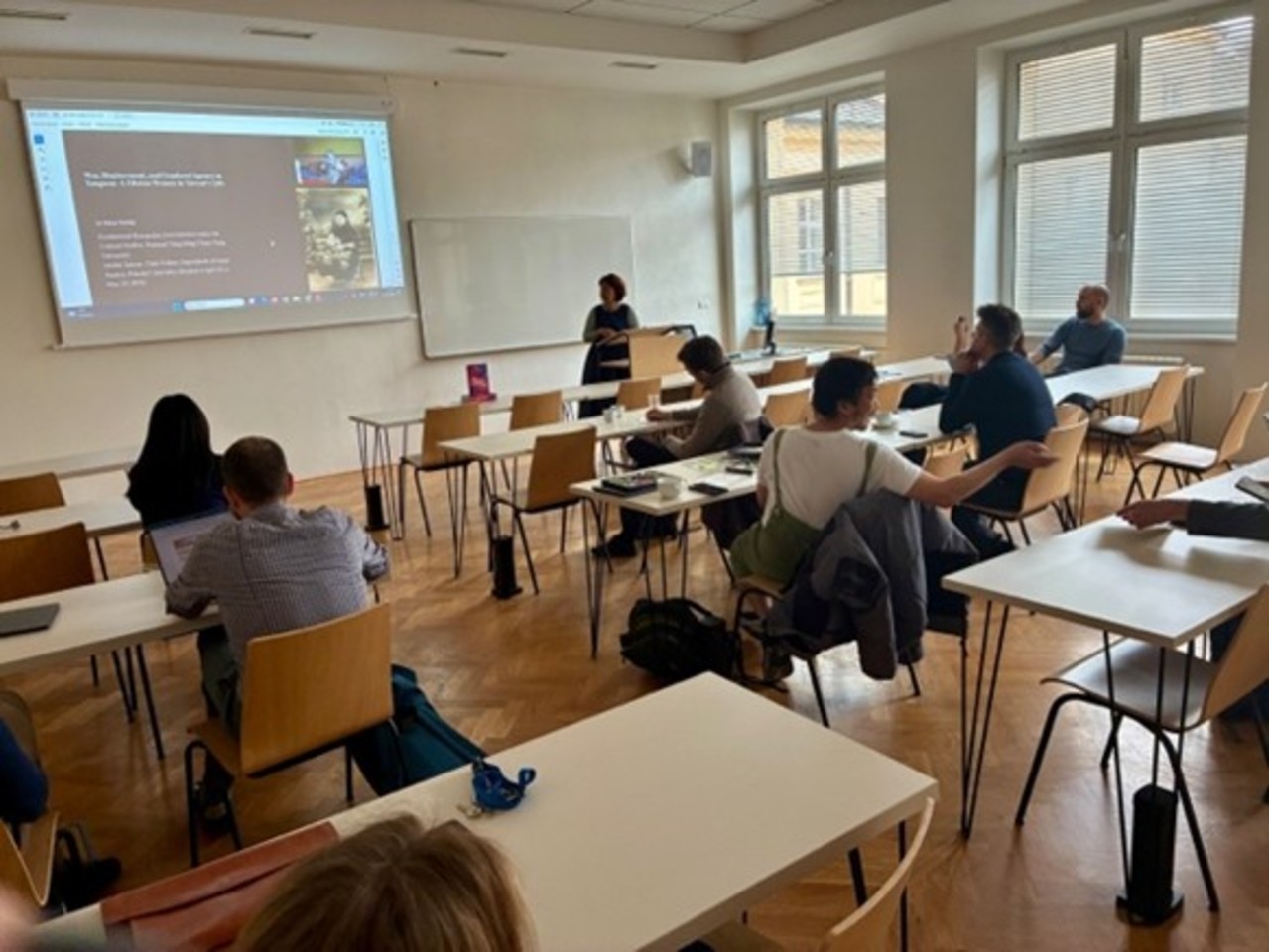
My final engagement under the fellowship was a presentation at the Czech Association of Contemporary Asian Studies (CACAS) meeting at UPOL. In a forum where much of the scholarly attention was directed toward public opinion and the macro-political dimensions of cross-strait relations, a presentation foregrounding the experience of a Tibetan woman in Taiwan, interrogating gender dynamics in the contexts of war and displacement, constituted a necessary and generative intervention into what had largely been a geopolitics-centred discussion. A complementary presentation by Taiwanese illustrator Peng Hsiung Hsu further shifted the register of enquiry toward diasporic Taiwanese perspectives on Czech culture and society, enriching the forum's comparative and cross-cultural dimensions.
I am deeply grateful for this fellowship. Within a month, I delivered three scholarly presentations and submitted two op-eds for publication. As a stateless person, travelling to Europe presents persistent difficulties arising from the securitisation of borders. However, whenever such access was possible, I carried out my research on Tibetans in Taiwan, including those living in conditions of statelessness, as both scholarly enquiry and lived testimony.